why we built dōpo
5 reasons to ditch the nightcap.
The glass of wine does something real. For a while, the day loosens its grip. But the same drink that unknots you at 10 can have you staring at the ceiling by 3, as it wears off. If the wind-down keeps waking you up, it might be worth a different pour.
P.S. The nightcap earned its spot for a reason. We just think the ritual is the part worth keeping.
Start with reason one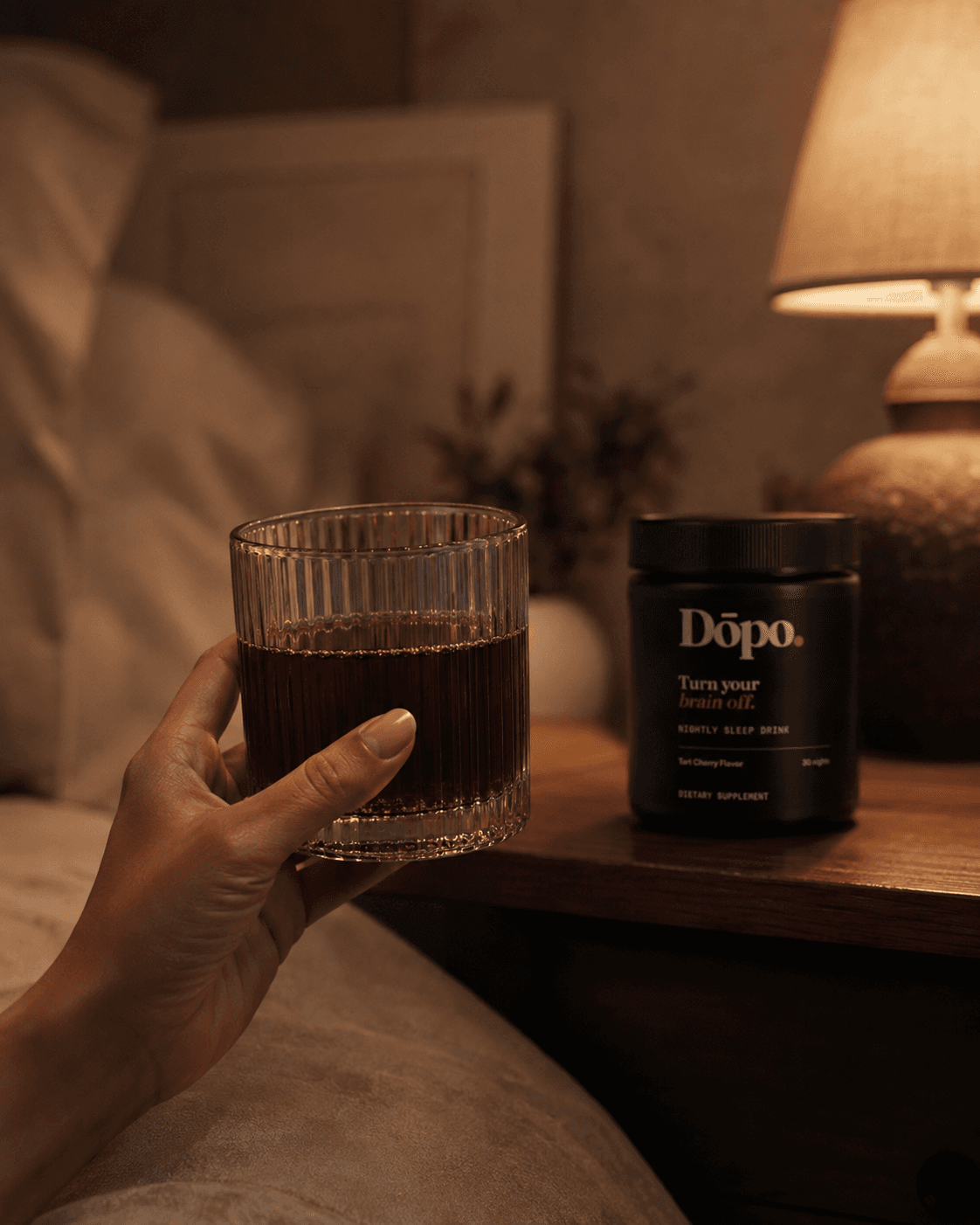
the honest part
It works for the first half. Then it turns on you.
Start with the part most people agree on. A glass of wine can genuinely take the edge off. Alcohol is a sedative, and in studies of healthy adults it can shorten the time it takes to fall asleep, at least at first. For many people that early softening is real. It is exactly why the nightcap earned its place on the counter.
But sleep researchers describe the effect as biphasic, two-faced. The same drink that can settle the first half of your night tends to disrupt the second half, as the body clears the alcohol and blood-alcohol levels fall. The trade does not register at 10pm. For many people it lands around 3.
Sources: Sleep Foundation, Colrain, Nicholas & Baker (2014).
the 3am club
The 3am wake-up has a name. The timing often lines up with the wine wearing off.
You know the one. You went down easy, and then somewhere around three you are wide awake, and your brain has switched back on like it never got the memo you were done. That is not a random bad night. Often, it is the back half of the biphasic curve.
As the alcohol leaves your system, the sedative effect reverses. Reviews of non-dependent drinkers describe the second half of the night getting lighter and more fragmented, with more awakenings, as blood-alcohol levels drop. The Sleep Foundation puts it plainly: fragmented sleep and frequent awakenings, especially during the second half of the night when blood alcohol levels begin to drop.
And this is drawn from healthy, non-dependent drinkers at moderate amounts, where the pattern is clearest in the second half of the night and sharpens as the pours get bigger. It is a quirk of the chemistry, not a verdict on you.
Sources: Sleep Foundation, He, Hasler & Chakravorty (2019).
the hidden tax
It quietly borrows against your dreaming sleep.
There is a quieter cost than the 3am wake-up. Alcohol can suppress REM sleep, the dreaming stage researchers link to memory and emotional processing. At moderate doses, studies of healthy, non-dependent drinkers tend to find less REM across the night. The effect sharpens as the pours get bigger, and at the lightest doses the studies do not always agree it shows up at all.
You never notice REM while you are in it. You notice its absence the next day, in the flat, one-coffee-short morning that studies link to drinking before bed. You can spend a full night in bed and still lose part of it to a tax you never agreed to.
First half
In studies, sleep came on faster and held together more.
Second half
In studies, this half ran lighter and more broken as the alcohol cleared.
All night
Across the night, studies tend to find less REM, pushed later and cut short.
The arc above is the general pattern sleep researchers document for a nightcap in healthy adults. It strengthens with dose and is debated at the lightest end. It is not a measurement of any one night or any person.
Sources: Colrain, Nicholas & Baker (2014), He, Hasler & Chakravorty (2019).
So we built a wind-down that keeps the ritual and leaves out the alcohol.
the switch
Keep the pour. Lose the alcohol.
The nightcap is really two things bundled together. A ritual you love, and the alcohol that comes with it. Dōpo keeps the first and drops the second. One last pour that tells the day it is over, made with four ingredients you can read and pronounce, and no alcohol in the glass. The benefit is the ritual, and every active amount is disclosed.
the formula, in the open
Four things, every amount stated.
Glycine
3 g
L-theanine
200 mg
Magnesium bisglycinate
200 mg
Lemon balm leaf extract
300 mg
the honest boundary
No alcohol to clear. No outcome we cannot back up.
Dōpo contains no alcohol and adds no melatonin. It is a nightly sleep drink, not an insomnia treatment. Every active amount above is disclosed on the label.
These statements have not been evaluated by the Food and Drug Administration. This product is not intended to diagnose, treat, cure, or prevent any disease.
the product offer
A nightly ritual you can actually keep.
Subscription only, one 30-night tub every 30 days. No alcohol in the glass, and every final active amount disclosed.
First-order offer
$27.50$55
First jar 50% offYour first 30 nights: 92¢ a night
Then $55 every 30 days. Skip, pause, or cancel in one click.
the trust wedge
Same ritual. Without the alcohol.
The part of the nightcap worth keeping was never the alcohol. It was the pour, the glass in your hand, the quiet minutes, the signal that the day is closed. You get to keep all of that.
What changes is what is in the glass. No alcohol to clear at 3am. No melatonin in it either. Every final active amount is visible on the shipped label, and Dōpo uses no proprietary blend. The ritual stays. The alcohol does not.
- Keeps the ritual, drops the alcohol
- Every final amount disclosed, no proprietary blend
- The shipped label shows what goes in
- Melatonin-free, on purpose
First-order offer
$27.50$55
First jar 50% offYour first 30 nights: 92¢ a night
Then $55 every 30 days. Skip, pause, or cancel in one click.
before you buy
Questions, answered plainly.
Is Dōpo a treatment for insomnia?
No. Dōpo is a nightly drink, not a treatment for insomnia, anxiety, or any medical condition. If your sleep is a health concern, that is a conversation for your doctor.
Do I have to stop drinking to use it?
No. Dōpo just takes the alcohol out of the bedtime pour. Keep the wine with dinner if you like it. Dōpo is a wind-down with no alcohol in the glass.
What happens when I tap Buy now?
It opens Dōpo's purchase surface. The offer is first jar 50% off: $27.50 for your first 30 nights, instead of the regular $55, then $55 every 30 days, free shipping. Buy now starts the order, and skip, pause, or cancel in one click.
What is in the formula?
Dōpo lists glycine 3 g, L-theanine 200 mg, magnesium bisglycinate 200 mg, and lemon balm leaf extract 300 mg. Every active amount is disclosed.
the last pour
Time for your brain to clock out.
The same quiet minutes and the same glass in your hand, with no alcohol in it.
First-order offer
$27.50$55
First jar 50% offYour first 30 nights: 92¢ a night
Then $55 every 30 days. Skip, pause, or cancel in one click.
sources
The claims about alcohol and sleep above are scoped to what these sources support, and each one describes healthy or non-alcohol-dependent drinkers, never a finished-product outcome for Dōpo. The brand lines around them are positioning, not clinical claims.
- Sleep Foundation. Alcohol and Sleep. https://www.sleepfoundation.org/nutrition/alcohol-and-sleep
- Colrain, Nicholas & Baker (2014). Alcohol and the Sleeping Brain (Handbook of Clinical Neurology). https://pmc.ncbi.nlm.nih.gov/articles/PMC5821259/
- He, Hasler & Chakravorty (2019). Alcohol and Sleep-Related Problems (Current Opinion in Psychology). https://pmc.ncbi.nlm.nih.gov/articles/PMC6801009/
If gummies were your exit ramp, not wine, read the companion piece: 5 reasons to ditch melatonin →